Our kids face mind-bending challenges in the AI world that no one can ever imagine. I share raw observations, practical learnings, and hands-on projects to join parents and educators on this adventure.
The premium touch in AI era
|
Lately, I’ve been slowing down. Reading more, thinking more, and following my curiosities. One area that keeps drawing me in is how we learn, especially children's learning. Maybe it’s because I didn’t have much of it myself. My parents worked incredibly hard to give my sisters and me a good life. But since they weren’t educated, I never read any books outside school, never played board games at home, and never had an environment to discover new things in my childhood. Maybe that’s why, as a dad now, I spend so much time helping my two daughters learn and explore. This desire led me to wonder about the future, but where to start? I wanted to start with imagination (something I honestly think I lack of), then see how I can reverse it to solve current problems in learning. So I picked up AI 2041 by Kai-Fu Lee. I was recommended because Lee partnered with a storyteller to share his AI insights in a fictional way. I’m not a big fiction fan (no wonder I lack imagination), but 10% in, I already feel like I’m glimpsing the future.
So many new ideas have already surfaced. One idea that stuck with me is the role of humans and AI. I feel that AI won’t just create, it’ll consume too. But that doesn’t mean humans will just take a backseat and do nothing. From what I see: Human will = premium. I can picture a future with AI doctors handling basic cases like the flu or a sore throat, while human doctors focus on edge cases that require deep insight. Or AI tutors guiding students through standard content, while premium tutors specialize in tailored techniques. And in my world of content and education, AI will handle all the work behind the scenes, but the last and most important part of showing up, that will still be a human being. This person becomes the anchor, taking in information, processing it, and expressing it with flavors. It is sort of happening right? The biggest creators all work this way! A lot more entrepreneurs are showing up themselves to scale their business. I think it will become the default way for everyone of us. That also made me reflect on the kind of content that draws people in, especially as we move deeper into the AI era. A few years ago, when AI wasn’t here, I felt fine posting quick opinions or thoughts on a text platform like Twitter/X. But now? This format didn’t work anymore. I can just tell from my own behavior consuming things now. If it is a short text post that anyone can copy and paste and still sound like they wrote it, then it is the kind of content that makes me go, “Ugh, not again.” So what’s missing there? I looked at what I stopped to read in the last few days - short and long posts with someone sharing a story: what they were doing, what they were feeling, what they were figuring out. There was an action in real life, then there was a post recapping it. But I also realized that if it’s from someone I already have a connection with, I’m more likely to read it. For a new person to catch my attention, it has to take one thoughtful post with some kind of stories and real reflections. Reflecting on this helped me see something clearly:
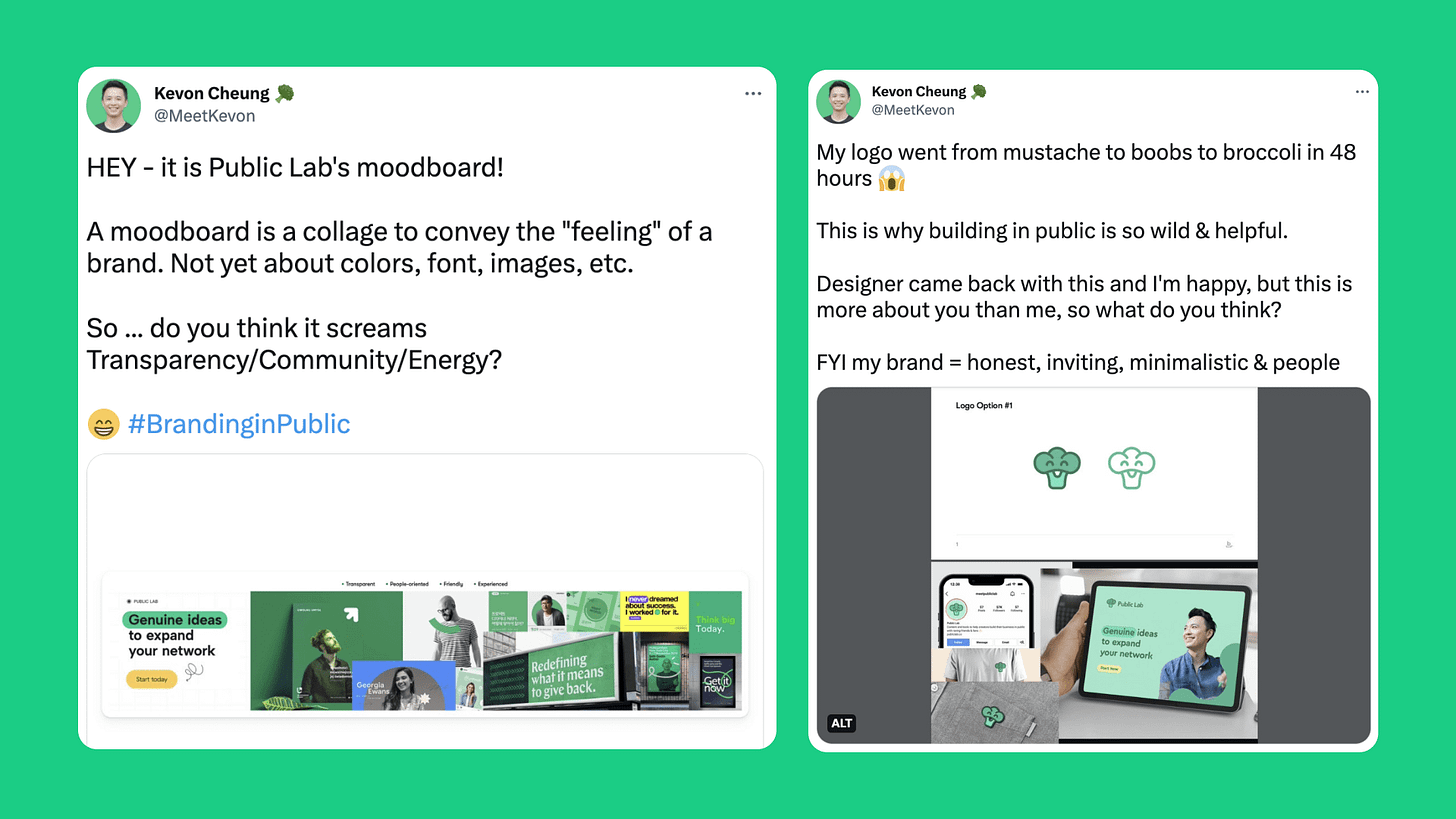
And that helps me come full circle. A year ago, I got frustrated with “building in public”. I felt like the topic was getting stale. So I rebranded and expanded my coverage of topics. But now it is so clear to me that storytelling is more important than ever. Building in public is exactly about “making an action in real life, then creating a story around it so more people know.”
How do I know? Summer’s around the corner, and my wife and I have been talking about what summer camps to enroll our daughters in. The topics that connect to storytelling are right at the top of our list. I’m also working with a client right now on developing his storytelling muscle. And I can see firsthand how hard it is for most people. The hardest part is not crafting the story, but noticing that they have so many story seeds each day. My conviction is that a lot of people can’t even capture their own stories in their day-to-day. All of these are telling me the same thing … Last Monday morning, I woke up at 5:30 AM and couldn’t fall back asleep. I opened my laptop and changed everything back to Public Lab.
Sorry Small School (the new brand). After 12 months, you now have to go! Hi Public Lab, you’re back! I decided it’s time to focus again. To go deeper into the storytelling side of building in public. I wonder if there are fun and easy ways to help people draw their stories out. I don’t know exactly where this will lead me. But I’m excited to explore it. And I’ll be sharing more as I go. Reader, hope you enjoy this read. Talk to you soon! — Kevon |
![Book Corner: “AI 2041 – Ten Visions for Our Future” by Kai-Fu Lee and Qiufan Chen [English] / up2date – Das Onlinemagazin der Universität Bremen – University of Bremen Online Magazine](https://substackcdn.com/image/fetch/w_1456,c_limit,f_auto,q_auto:good,fl_progressive:steep/https%3A%2F%2Fsubstack-post-media.s3.amazonaws.com%2Fpublic%2Fimages%2F8d023130-46b9-4021-82f8-eb5b60184519_1300x975.jpeg)

Public Lab Newsletter
Our kids face mind-bending challenges in the AI world that no one can ever imagine. I share raw observations, practical learnings, and hands-on projects to join parents and educators on this adventure.
4.5 years ago, I stumbled into something that completely changed how I share and grow: building in public. Today, I’m sharing what I’m building after getting burned out 12 months ago. I took my time to search for it and I’ll also tell you why I think it matters now more than ever. Ready? I want to bring you back to 4.5 years ago when I discovered the topic “building in public”. If you don’t fully understand this strategy, let me try to share it in 5 seconds: you’re sharing stories around what...
Last week, I shared how golf helped me climb out of a year-long low. But what I didn’t mention was… I almost picked archery. If I did, I could still be in my low. This reflection inspired me to share today: Why I wanted to pick up archery at first How my thought process helped me switch to golf What you can do when facing new opportunities in life Archery seemed perfect on paper Let’s go back about 7 months ago, when I felt mentally and physically stuck. I was always sitting at home or in my...
Once again, and likely the final time, I’d say it: 2024 was a tough year for me. I felt stuck. I felt stagnant. Oh, and I also felt hopeless. My wife was right there watching me and later told me, “I didn’t know how to bring it up to you.” I was reconnecting with an old friend, Ankita Kulkarni (her X and YouTube), last week, and we circled back to this topic. And that triggered a series of reflections in me — especially what got me into this state and what shift I had taken to recover from...